

What Is The Chemical Makeup Of The Air We Breathe
Published June 8, 2020
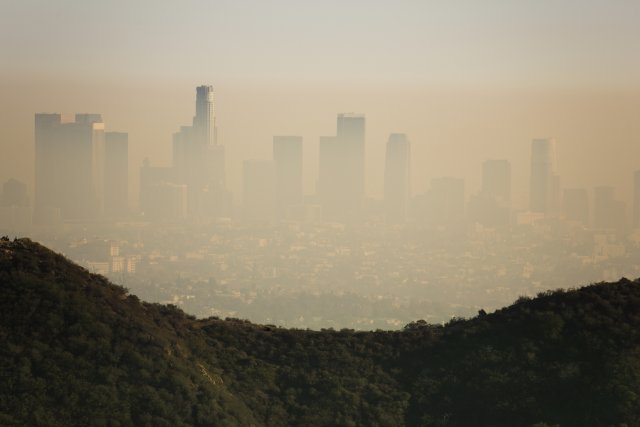
EPA has been at the forefront of providing the science to protect the air we breathe since 1970, when the Agency was established. Fifty years agone, air pollution (smog) was a visible problem. These loftier air pollution concentration days resulted in respiratory problems and illnesses and sometimes hospitalizations and deaths.
In 1971, EPA announced the National Ambience Air Quality Standards (NAAQS) on half dozen common air pollutants under the Clean Air Act. Currently, the six criteria pollutants are ozone, particulate matter, carbon monoxide, atomic number 82, sulfur dioxide, and nitrogen dioxide. Critical research by the Bureau and others have supported the review of the standards and offered the science to implement them past united states.
EPA formed a multidisciplinary research program to support the NAAQS that focused on studying how people are exposed to pollutants, what the effects are from exposure, what sources were causing increased emissions, and how emissions could exist effectively reduce or mitigated. The Agency established inquiry laboratories in Enquiry Triangle Park, NC, which still serve equally a national center for air pollution research and policy. In nearby Chapel Loma, on the campus of the Academy of Due north Carolina, EPA prepare upwardly labs to coordinate research on the health impacts of air pollutants.
Some of EPA's primeval air pollution research investigated the photochemical reaction of chemicals emitted past the called-for of fossil fuels from vehicles and industrial sources. On warm days, the interaction between sunshine and some air pollutants provides weather to produce ozone. Basis-level ozone, also referred to as smog, became a wellness problem in many cities, such as Los Angeles. This air pollutant irritates the pharynx, and was shown to pb to respiratory problems in children and adults, that sometimes resulted in hospitalizations.
Ongoing ozone research in the 1980s and 90s helped to improve understanding of the health effects of the pollutant and contributed to the revision of the air quality standard for ozone in 1997. Research over the adjacent two decades showed a potent relationship between ozone concentrations experienced during the course of the day and dumb lung function. This and other findings supported additional revisions to the ozone standard.
Some other air pollutant, particulate matter (PM), also referred to every bit soot, is too a public health hazard. The first PM standards in 1971 focused on all particles suspended in air from a variety of sources. So, in 1987, EPA revised the standard after research showed a specific size or "fraction" of PM called PM10 could enter the lungs. Eventually, mounting scientific evidence indicated potential health impacts due to tiny particles that are approximately 30 times smaller than the human hair, chosen fine particulate matter (PM2.five), which can travel deep into the lungs. These particles are primarily generated from vehicles, industry, wildfires, and other combustion-related sources.
EPA issued the offset air quality standards for PM2.five in 1997 based on scientific findings that exposure to fine particles can atomic number 82 to respiratory effects and even decease. As inquiry progressed, evidence revealed that PM2.5 could also lead to cardiovascular effects. Studies keep to improve EPA'due south understanding of the relationship between PM2.5 exposure and wellness effects, with a focus on those who may exist most at-risk of health effects.
EPA researchers go along to back up the review of the NAAQS with Integrated Scientific Assessments (ISAs) by evaluating the latest scientific findings on the health effects from air pollutants.
Enquiry to Implement the Air Quality Standards
As the air quality standards were developed over the years, the demand for ways to reliably and consistently measure out emissions became apparent. EPA researchers began studies to develop and accelerate air quality measurement capabilities. In 1998, researchers published a Federal Reference Method for measuring PM2.5 that assists states with implementing the NAAQS. Many Federal Reference Methods (FRMs) and Federal Equivalent Methods (FEMs) have been developed and evaluated by EPA researchers for air quality measurement since then. These tests and other monitoring methods are essential to air quality management.
More recently, EPA has been actively leading research to farther develop, evaluate, and implement the utilize of a broad array of Adjacent Generation Emission Measurement approaches and technologies for regulatory and non-regulatory purposes, including lower-cost, portable air sensors.
Atmospheric Modeling Supports Air Quality Management
EPA has been at the cutting border of atmospheric modeling as calculating technology advances accept been achieved. In 1998, researchers released the kickoff version of the Customs Multi-scale Air Quality (CMAQ) modeling system, which provides fast and technically sound estimates of ozone, particulate matter, toxics and acid deposition. CMAQ is continually updated and peer reviewed on a regular footing. It is used worldwide to support air quality management.
CMAQ also helps individuals larn about their air quality. The model played an important part in the evolution of the get-go national air quality forecasting adequacy by EPA and the National Oceanic and Atmospheric Administration. This led to the development of AirNow.gov, a multi-agency resource that provides electric current and forecast air quality maps and information for more than 500 cities in the U.Due south.
The ongoing report of air pollutants and the development of technology to mensurate, monitor and model emissions has led to improved air quality in the U.s.. Over the terminal 50 years, criteria air pollutants in the United States have been reduced past 74 percent leading to cleaner air for Americans. EPA inquiry continues to provide solutions to air quality direction challenges by states and tribes, investigate air quality issues such as wildfire smoke, and inform the public of potential health risks with enquiry to better public health communications. This scientific discipline continues to provide the foundation for protecting the air we breathe.
Learn More
Milestones in EPA's Air Quality Enquiry History
EPA Science Flashback: Air Quality Impacts on Public Health (Video)
History of Air Pollution
Air Monitoring Methods
Smog, Soot, and Other Air Pollution from Transportation

What Is The Chemical Makeup Of The Air We Breathe,
Source: https://www.epa.gov/sciencematters/how-science-protecting-air-we-breathe
Posted by: hammondsambeek1985.blogspot.com
0 Response to "What Is The Chemical Makeup Of The Air We Breathe"
Post a Comment